«Stillness is a state of polarity that always has movement as its complement”. I Ching
Ocata Beach. Photo by Xavi Padrós
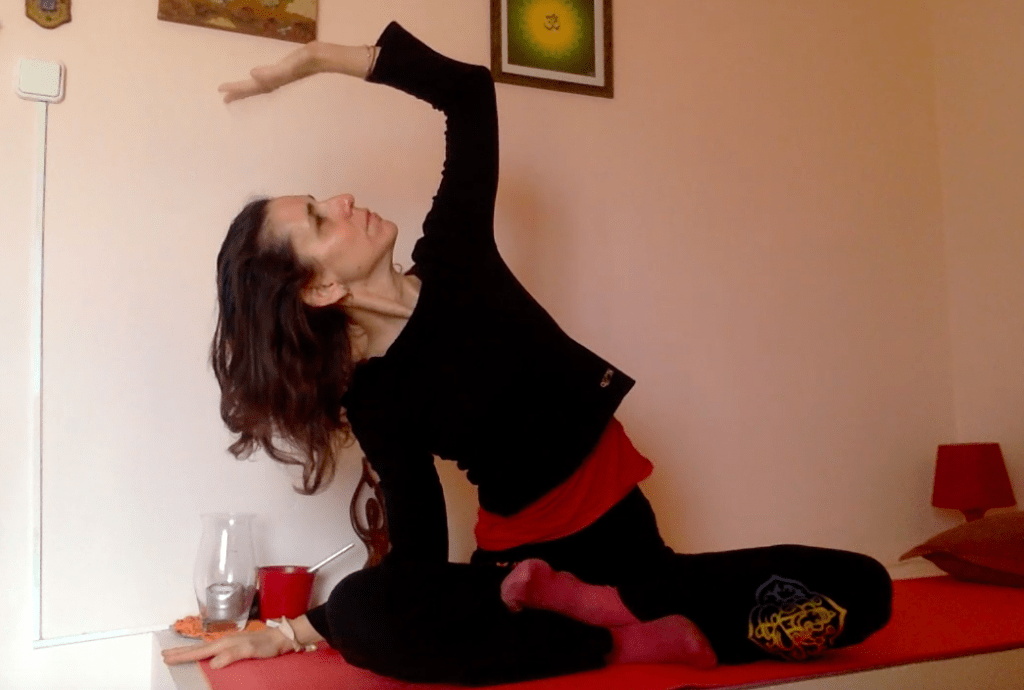
On this occasion I felt the need to practise one of the most basic and profound standing asanas, the Tadasana, the “Mountain” posture, with the objective of building a strong and solid structure.
The idea was brought up during my sadhana, my personal experience of yoga practice, and while holding this pose I had a revealing vision and realised that all the categories I combine in Holistic Psychology have a common goal: the study of the Self.
According to Ayurveda, which defines the meaning of Prakriti as our inherent individual nature, in Iyengar Yoga, the Svādhyāya, or the study of Self as in Jungian Analytical Psychology through the individuation process, is a path towards the knowledge of the Self that can be simple yet complex. This way of living implies commitment and responsibility towards ourselves, making us pause to take the time for self- observation.
While holding the Tadasana we are standing still and quiet, completely present in the moment at hand, resting for just an instant in the “now” without needing to know what might come next. The mountain symbolises the return to a state of internal stillness. We build a strong, firm foundation and establish the contact to access a more spiritual, higher knowledge.
In the I Ching, or the Book of changes, there is a hexagram that speaks about this:
“The image is the sign of the mountain, the bridge between the Sky and the Earth. Masculine energy is in the upper level, where it aspires to find harmony with its nature; feminine energy is in the lower level, towards which its movement is oriented. This way there is stillness, because movement comes to its natural end. Real stillness means keeping quiet when it is time to be quiet, and moving when it is time to move”.
In the practice of Yoga we work on this posture to find our own internal vision provided by this element of Nature.
With the latest global news that both informs and unites us worldwide, we must not fail to offer the information that Ayurveda can help to maintain a high level of energy and to aid the body’s defence by strengthening the immune system. In view of the current news it is inevitable that an environment of confusion and stress is created.
We all know that good immunity can help us to fight the virus, and a bad immunity creates a weakness in the body and mind to fight it and take the most of the inner mechanisms.
It is all about contamination and immunity is how we can fight CoVid19. It is important to understand that a VIRUS is not bad itself, but more so once it’s in the body that the effects takes place. This is related to the immunity one has. CoVid19 affects the Respiratory System so it is the place we have to take care of most when thinking of prevention and treatment.
The fact that it is a zoonotic virus, meaning it initially spread from animal to human being (which is still being studied), has created enough panic in society. It is known that cold climates are nutritious for the virus so the idea is to create a hot climate in our body.
Remember: It is not the virus which is killing people, but pneumonia.
To manage the immunity of the respiratory system is the key: protect our lungs and throat.
Phamarcy at home
Internal purposes
First recommendation: Start with Hot Drinks
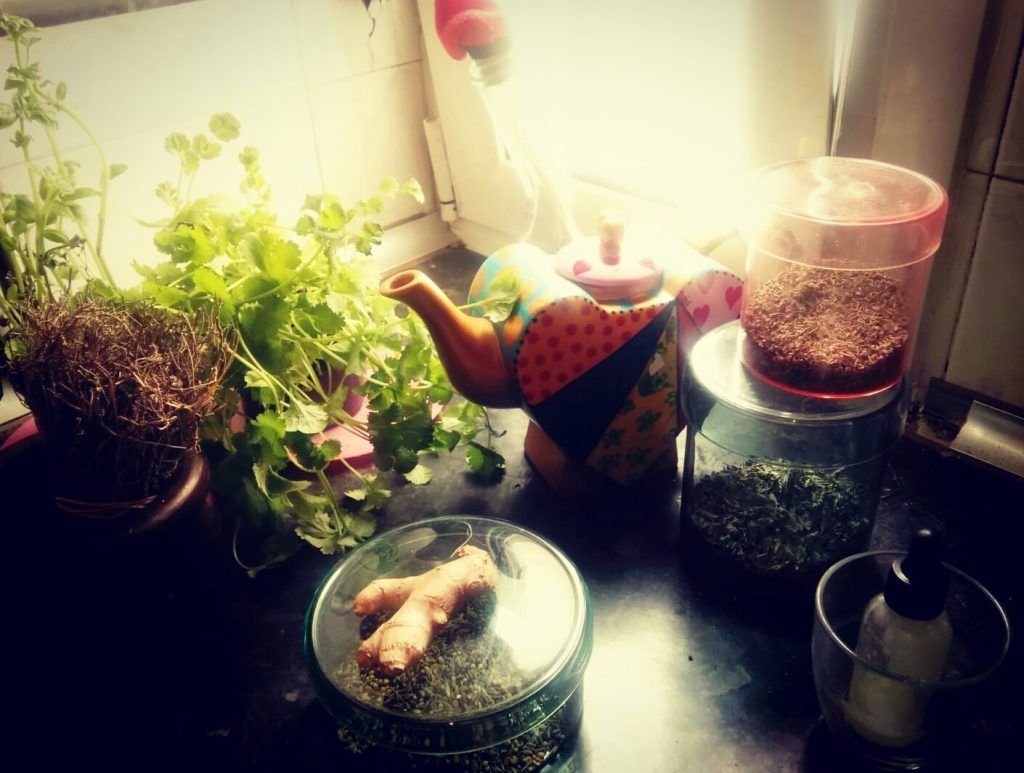
Drink hot water all day long and if you can add ginger even better. Hot water with ginger is the best to keep the body warm and create heat inside.
Include in your diet antiviral plants and ingredients in day to day routines such as: curcuma, black pepper, garlic, onion, clove, ginger, hingu (asofetida), tulsi.These herbs/items are ama pachana, that means that can digests toxins in the body.
Drink hot water/infusions throughout the day.(missing the herbal tea)Ayurveda recommends hot drinks (especially in winter and spring) to help eliminate toxins from the body. (here’s a link to a good infusion for this time)
Second recommendation: Pharmacy at home
Make a home remedy to have every day. Here is one formula we’d like to share with you:
Licorice + honey. Have this twice or three times a day.
Other option is to make your own formula using the following ingredients:
1 ginger part + 1 curcuma part + 1 licorice part + ¼ black pepper + ¼ clove.
Mix all the ingredients, put them in a glass with a cup and take a teaspoon every day with honey.
Sitopaladi churna is also good.
In order to clean the throat do Gandusha and Kavala using a mix of: Triphala + rock salt in curcuma decotion (video soon).This is helpful in the fist stage in symptoms of an itchy throat.
Chawanprash can also be a good rasayana for the Respiratory System.
Third reommendation: Eat well
Diet is very important, as a fact is our everyday medicine. Eat well and if possible fast once a week.
There are some items (spices) you can include in EVERY MEAL that are useful to prevent as well to treat VIRUS and strengthen the lungs. These spices are: curcuma, garlic, pepper and onion.
Here is a recipe that is nutritious, full of energy and to share with your family.
We know the impact of poor digestion and the creation of toxins in the body (ama). When we provide our organism with a rest of food, we encourage the strengthening of the digestive fire, this allows everything we can ingest to be transformed into nutrients and to be used as a source of energy for our body, our mind and our spirit.
Fourth recommendation: Stay calm
Breathe, meditate, at least once a day, do yoga, dance or the activity you like.
Yoga Online
Stress is an adaptive neuro-physiological response to external or internal changes in humans by adding cognitive-behavioral components that modulate the response.
When the stress response does not recover with a relaxation response, a burden is accumulated that produces the distress that makes you sick. Stress is good. Distress is not.
A maintained stress response generates the fight or flight response and deploys a series of physiological actions that accompanies it. This response is a conscious factor in the production of fatigue. It interferes with the body’s energy-producing systems, digestion and weakens the immune defense systems.
REMEMBER: Stress weakens the immune system.
This article was written under the assistant of Dr. Mahesh Patil Ayurvedic Dr. From Pune (write the name of your clinic).
Here I share here a very clear video from Dr. Vasant Lad from the Ayurvedic Institute
I was with Amparo in El Galpón in Badalona and asked her some questions…
In El Galpón, Badalona
Eliana: What is authentic movement? Amparo: Authentic Movement is a form of Dance Movement Therapy (DMT). It was created in 1950 by Mary S. Whitehouse, and later developed by Joan Chorodow and Janet Adler. Through a body and movement aproach, a greater state of self-consciousness is sought.
In our daily life movement is continuously present. It is the great law of life, everything moves. The clouds in the sky move with the wind, the water flows through the river bed until it flows into the immense sea, the fire travels and rises up the mountain with wind and the earth is in constant change and transformation.
Our body is a world of movement in itself: the circulation of blood, breathing, digestion and sleep are unconscious processes of movement which develop continuously from birth to death. However, we use little movement in communication, at least consciously. Words have become the main means of communicating despite being a limited way of perceiving ourselves and others. Nonverbal communication allows new and different ways of perceiving, feeling and relating.
Unconsciously movement communicates. From gestures, physical attitudes or how a person is dressed we have an impression of that person, it transmits an information to us, it evokes an image in our psyche perhaps coming from a memory or a fantasy. Small movements of hands, feet or face give a sense of restlessness or nervousness. There may be tension in raised shoulders or on someones voice. Fear may be present in limited and controlled movements. It’s something we feel automatically, without realizing it.
During the practice of authentic movement we pay close attention to all these details, both when we move and when we are witnessing the movement of another person. We are discovering something that we did not know about ourselves in a context that facilitates the opening for this discovery and its subsequent integration. In this way unknown aspects that come from internal listening of the body, in the form of sensations, images or emotions that emerge through movement or stillness, are integrated.
We discover the intimate connection of body and psyche through experience. We discover that the physical condition is somehow the psychological condition. Just as the body changes through working with the psyche, the psyche changes working with the body. They are not separate entities but a mysterious totality. In this sense, from the practice of authentic movement, the body is perceived not as something alien, an object that we can train or manipulate, but as the house where our feelings, our emotions and memory live. It is a place to inhabit, discover, listen, transform …
The movement thus becomes an experience. We experience the truth of our body, what it wants to express, show, unlock, recover, articulate, save, confront, unite, separate, … ultimately what we have to live. The axis around which all this work is articulated is the relationship between the mover and the witness. The mover remains with his eyes closed, bringing his attention to inner listening, waiting to feel an impulse that leads him to movement or to stillness and deep rest. Who observes, silently accompanies the experience, attentive to his own internal experience as a witness, enabling the creation of a respectful, safe space, in which the judgment or interpretation of the material that emerges is not involved.
E: How does authentic movement practice relate to Jung’s analytical psychology? A: Authentic Movement can be practiced for psychotherapeutic purposes, as a meditative practice or as a creative resource.
In the beginning, the practice of authentic movement was closely linked to analytical psychology and C. G. Jung. It arose from Mary Whitehouse’s need to integrate her work as a dance teacher and her analytical process with Hilde Kirsch, a Jungian analyst from Los Angeles (CA) who was trained with Jung. Recently divorced, and with two children in her care, Whitehouse needed to work and dance was her job. However, both her training with contemporary expressionist dancers Mary Wigman and Martha Graham, as well as her Jungian analysis, slowly led to a new understanding of herself, of dance and of the world around her. This made her undertake a search that materialized in the practice of authentic movement, where her entire process found meaning.
As an authentic movement teacher, Whitehouse provided a context of openness and tools for her students to discover something new and different from themselves through body and movement. This creative aproach, present in Jung’s principle of individuation, encourages everyone to seek their own path, honoring the uniqueness of each person. In this sense, authentic movement is not intended to be a method or a theoretical approach to movement. Whitehouse used to tell her students that movement could not be imposed from the outside as a suit or choreography, but rather should be searched and found internally. Jung developed in his book “The Secret of the Golden Flower” the concept of Wu wei, which means to be able to let something psychically happen, non-action in action and action in non-action, a principle of totality that governs life according to Taoism.
Whitehouse takes this principle and applies it to movement in the sense that: if we do nothing we let something happen, we let something move us from the body, we let the body be. She Illustrates this concept through the difference between moving and being moved. To be moved is the experience of life expressing it self, to be moved is to let oneself be.
It also uses Jung’s active imagination in movement as a way to integrate unconscious contents. It proposes a symbolic approach to understand internal and external events. The practice follows a process orientation, where the emphasis is placed on the discovery and experience of the psychic reality of the unconscious through the body. Without this experience our perception of reality and the world is incomplete. Perceiving the world implies an introversion, making contact with an internal psychic reality that is alive and moving within us. This is why after taking a session of authentic movement we have the feeling of something that makes sense, of something that is ben completed.
E: Is the practice done in a group or individually? A: The practice can be in a group or in individual sessions. It is more organic to start with individual sessions and after some practice try in a group. The experience you have is very different. Different aspects are worked out. In an individual context, the relationship between the witness and the mover becomes more relevant, where they can work from pre-verbal related aspects to the relationship with the internal authority or Self.
This is a process that develops in what Jung describes as the ego-Self axis. In a group context, we work in relation to a group process where aspects of relationship with the collective emerge, and the relationship between the individual and the collective becomes more relevant. Analytical psychology offers a fertile context to elaborate and work in a process those aspects that emerge from the practice of authentic movement giving them meaning and enabling an expansion of consciousness.
E: Can everyone engage in authentic movement? A: As it is a practice that is destined to work with the unconscious, it is aimed at people with an ego structure that allows a descent into the depths of the psyche. Each case must be carefully evaluated. In people with psychosis or borderline personality disorders, this practice is not advised since it can greatly challlenge ego structure.
A previous interview is recommended, and starting very slowly, creating a strong container and sufficient body, kinesthetic and proprioceptive awareness so that the body can sustain the process and be sufficiently aware of what is happening internally.
Sometimes practices that make use of the body as a therapeutic tool are too cathartic, and body-psyche connection is lost or severely impaired. We must always be attentive to our own personal limits, maintaining a strong position of self-care. We follow the homeopathic principle according to which “less is more”.